
Acoustic treatment of a bedroom while listening to music
A bedroom is the most inconvenient room for serious listening. The bed is against the wall, the wardrobe opposite, a window on one side — it's almost impossible to achieve a symmetrical seating arrangement. At the same time, the request to 'listen to a record before bed in the evening' comes to us consistently: in 2025, there were 14 such orders, 9 of which were specifically bedrooms of 14–22 m².
Let's break down what really works, step by step.
Why a regular bedroom sounds bad
Soft bed, carpet, thick curtains, pillows — all these absorb mid and high frequencies. But the bass has nowhere to go: a 50 Hz wavelength is 6.8 meters, it calmly wanders between the walls of a 4-meter room, forming standing waves. The result is an imbalance: no highs, bass hums on one or two notes.
Last year, we measured a 16 m² bedroom for a client in Zelenograd. RT60 at 4 kHz was 0.22 s (dry, like in a studio), and at 80 Hz it was 0.91 s. A fourfold difference! Any jazz bass in such a room turns into a monotonous hum.
The impulse response — Dirac's function — immediately shows this picture: the spectrogram reveals “tails” at modal frequencies that last three times longer than they should. The standard Thiele–Small method from 1965 with sine signals will not show this; its efficiency in a real room is 1.5–5%, whereas the impulse response provides full correlation with what the ear hears.
Where calculation begins: 3D scan and modal analysis
Before any treatment, we perform 3D scanning. This is not a whim — without precise geometry, it's impossible to calculate the room's natural resonances (modes). The formula is simple: f = 172 / L, where L is the side length in meters. For a typical bedroom of 3.5 × 4.2 × 2.7 m, the modes fall at 49, 41, and 64 Hz — right in the main range of the bass guitar and kick drum.
After the scan, we count three things:
- Modal map along three axes – where pressure peaks and dips will be;
- Required absorption by bands 63 / 125 / 250 / 500 / 1000 / 2000 / 4000 Hz for target RT60 ≈ 0.3–0.4 s;
- First reflection points from side walls, ceiling, and floor relative to the seating position.
The target RT60 for listening to music in a 15–20 m² bedroom is 0.30–0.35 seconds, flat across the entire range from 80 Hz to 4 kHz. This is much more difficult than just making it “dead”.
What do we install: bass traps, diffusers, spot absorption
There are three critical zones in the bedroom.
Corners — for bass. Corner bass traps 40–60 cm thick made of mineral wool with a density of 40 kg/m³ with a mandatory air gap are used here. Without a gap, the trap loses 30–40% efficiency at 60–80 Hz — this is not our hypothesis, these are measurements from two dozen objects. We hide the traps in a cabinet niche or in the bed podium so that the bedroom does not turn into a studio.
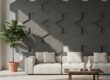
First reflection points – for the mid-range. Side walls at the ear level of a sitting/lying listener. Thin panels 5–8 cm thick with fabric upholstery work here. They can be integrated into the headboard of the bed — we had a project in St. Petersburg, on Krestovsky Island, where we covered the entire headboard with acoustic felt with a pattern — the guest would not guess that it was a treatment.
Rear wall — for diffusion. If the listener is sitting on the bed, there is usually a wall with a wardrobe or paintings behind them. Diffusers are needed here — two-dimensional Schroeder or skyline diffusers. They do not muffle the sound but disperse it, preserving the 'air' in the recording. Without diffusion, an over-treated bedroom sounds dead, like a closet.
What to do if the renovation is already done
The most frequent request: “everything is ready, can we add something?”. Yes, and quite a lot.
We disguise corner traps as floor lamps or hide them behind full-wall curtains. We replace the headboard with an acoustic one — it doesn't look like a modification at all. On the ceiling above the bed, we install a cloud made of perforated plasterboard with mineral wool behind it. One of our clients in Kazan made such a cloud with perimeter lighting: both acoustics and a night light.
Sometimes the client is categorically against any visible panels. In such cases, we use “hidden” treatment: niches behind curtains, acoustic ceilings, special furniture filler. It's 30–40% more expensive, but visually you won't notice anything.
But what you definitely shouldn't do: glue foam “pyramids” from a hardware store. They only muffle the highs (4–8 kHz), while the problem in the bedroom is in the bass. You'll get an even brighter and more unnatural sound — proven by dozens of reworkings after “DIYers.”
Frequently asked questions
How much does it cost to treat a 15 m² bedroom?
Budget option with corner traps and a couple of wall panels — from 180–220 thousand ₽ turnkey. Full treatment with hidden solutions, diffusers, and integrated headboard — 450–700 thousand ₽. The price depends on finishing materials and the complexity of concealing structures.
Is it possible to do without measurements and order panels immediately?
You can, but it's a lottery. Without a 3D scan and impulse response measurement, you won't know where your modes are and what the real RT60 is. In three out of four cases, “panels by intuition” either don't help or make things worse. A measurement costs 25–35 thousand and pays for itself immediately.
Won't the bedroom sound dead after treatment?
No, if the goal is RT60 = 0.3–0.35 s and diffusion is used on the back wall. A room becomes dead at RT60 below 0.2 s across the entire range — this is studio mode, uncomfortable for a living space. We specifically leave “air” in the upper midrange.
Need acoustics advice?
Leave your contact — we'll respond within 30 minutes and calculate the cost