
Square room for a home theater: problems and solutions
When the client from Balashikha sent us the layout of the future home cinema – 4.5 by 4.5 meters, height 2.8 – we immediately honestly said: it will be hard work. A square with a low ceiling is an acoustic nightmare. And yet, the final report after three months of work showed an RT60 of 0.32 seconds at mid-frequencies and a uniform frequency response of ±3 dB. Below, we explain why engineers dislike square rooms so much and what can be done about them.
What's wrong with the square for cinema?
Any room is a resonator. Sound waves, reflecting off parallel walls, at certain frequencies combine with themselves and form standing waves – room modes. When the wavelength is a multiple of the distance between the walls, pressure in some points of the room is off the charts, in others – almost zero.
In a rectangle, three sets of modes (length-width-height) fall on different frequencies, and dips and peaks are distributed somewhat. In a square, length equals width – meaning the first mode along the length and the first along the width land on the same frequency. Energy doubles. For a client from Balashikha, 38 Hz and 62 Hz modes caused an overlap of +14 dB in the corner behind the sofa and a dip of minus 18 dB exactly at the listening position.
This is not 'a hum you'll get used to'. This is directly in the soundtrack zone: explosions turn into mush, the narrator's voice floats in volume depending on whether you're sitting or standing.
Why standard calculations don't work here
Subwoofer and speaker manufacturers specify parameters using the Thiele-Small method – these are 1965 sine signals, yielding 1.5–5% efficiency. This is suitable for a box in an anechoic chamber. For a square room with its modal grid – no. The figure 'frequency range from 28 Hz' means nothing if at 38 Hz the room itself cancels that frequency to zero.
At 360° Space Acoustic, we calculate using impulse response – Dirac's function. It shows the real behavior of the 'room + speakers' system in time and in the frequency domain simultaneously. The impulse shows not only where the dip is, but also exactly how many milliseconds the modal 'aftersound' (decay) lasts. In a square room, a typical picture is – at 60 Hz, the decay stretches for 0.9–1.2 seconds. At mid-frequencies – 0.3. That is, the bass 'lags' behind the image by almost a second.
The objective impulse response picture fully correlates with what a person hears. Without this measurement, planning treatment is guesswork.
How we treat the square
First – 3D scanning. A camera on a tripod goes around the room, we get precise geometry (including niches, beams, wall curvature – which are almost always imperfect). Next – calculation of modes, modeling of first and second order reflections, design of treatment zones.
From experience, for a 4.5×4.5×2.8 square room, four techniques work:
- Bass traps in all eight corners. Not only in the lower corners — modal pressure is maximal even near the ceiling. Minimum depth 40 cm, material — basalt wool with a density of 60–80 kg/m³ behind acoustically transparent fabric.
- Asymmetric distribution of absorbers. The left and right walls should not be mirror images of each other, otherwise lateral reflections converge at one point and kill the stereo image.
- Diffusers on the back wall. 2D Schroeder diffusers with quantization depth below 200 Hz — they scatter energy instead of absorbing it, and preserve air in the sound.
- Suspended ceiling with a gap. To change the effective height in the MLP (main listening position) zone — this shifts the vertical mode into a safe range.
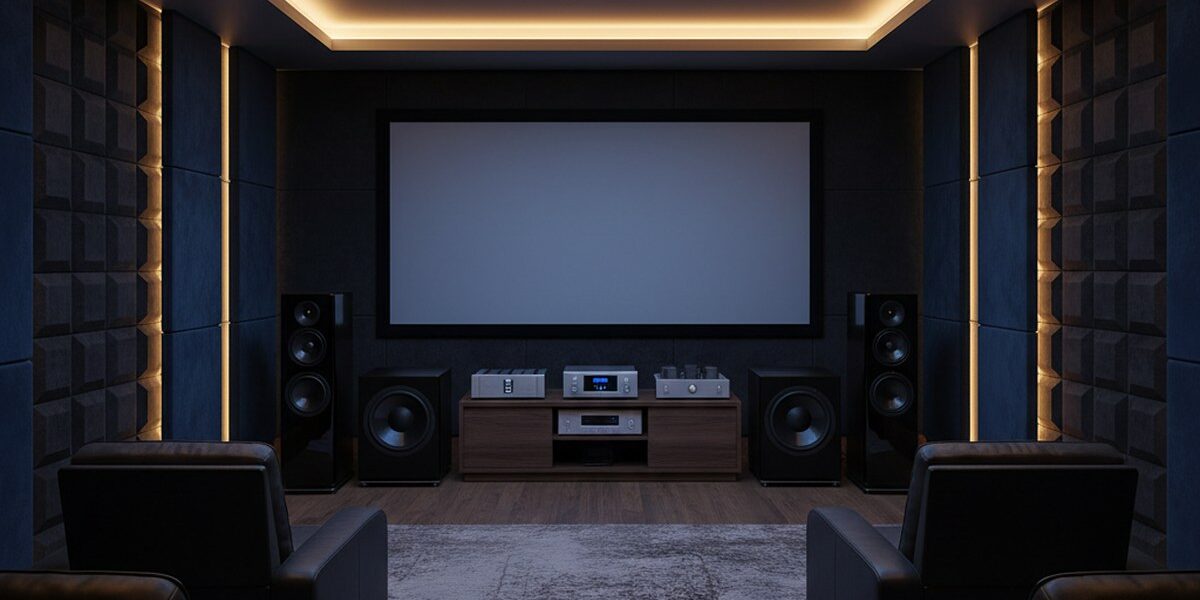
At the facility in Balashikha, about 14 m² of absorber, six corner traps, and a 2.4×1.2 m diffuser on the back wall were used. The turnkey budget was about 680,000 rubles. After measurements – RT60 of 0.32 s at 500 Hz, frequency response uniformity ±3 dB from 50 to 16,000 Hz. The client heard for the first time how Hans Zimmer in Dune sounds without 'muddiness'.
When the square cannot be treated
There are cases where it's more honest to decline. A square smaller than 3×3 – where modes creep into the speech range, processing without losing useful volume is unrealistic. A square with a ceiling below 2.4 – the vertical mode overlaps with horizontal ones, the room becomes a resonator along all axes.
In St. Petersburg, there was a case: a client bought an apartment in a new building, allocated a room of 3.2×3.2×2.3 for a cinema – almost a cube. We calculated that even with maximum treatment, the RT60 at 80 Hz could not be brought below 0.7 seconds. We offered two paths: either a re-planning with a partition relocation, or abandoning a full 5.1 system in favor of a system with active bass correction and directional emitters. The client chose to move the wall – it turned out cheaper than 'fighting' with materials.
Therefore, the first thing we do when approached is not to offer materials, but to look at the geometry. Sometimes the correct answer is: 'not here'.
Frequently asked questions
Can one get by with only bass traps in the corners?
No. Traps remove modal peaks but don't fix dips and don't work on mid-frequencies. A complex solution is needed: bass traps, first reflection absorbers, diffusers on the back wall. Otherwise, you'll get a dull sound without bass.
Will thick carpet and heavy curtains help?
A carpet reduces early reflections from the floor – useful, but it's 5–10% of the task. Curtains only absorb the top (above 1 kHz), they don't work at all on bass. For a square room with its modal problems, this is cosmetics, not a solution.
How much does it cost to treat a square room for a home cinema?
In our projects in Moscow and St. Petersburg, the budget for a 16–25 m² area is from 450,000 to 900,000 rubles turnkey, including impulse response measurements, project, materials, and installation. The price depends on the target RT60 and desired frequency response uniformity.
Need acoustics advice?
Leave your contact — we'll respond within 30 minutes and calculate the cost