
Projector or TV: how does it affect the acoustics of the cinema
With the advent of affordable 8K TVs and the improvement of projection technologies, the question of "projector or TV home theater acoustics" is becoming increasingly relevant. Many clients come to us with a ready idea of the visual part, but forget that the picture is only half the impression. Sound, or rather its correct reproduction, is critically important for full immersion.
In recent years, with the growing popularity of streaming services and the availability of high-quality content, home theaters have ceased to be the exclusive domain of enthusiasts. Now everyone wants to get the most realistic viewing experience, and here the focus is not only on the screen size but also on how the sound interacts with this screen and the surrounding space. We, at 360° Space Acoustic, constantly face the need to adjust initial plans for display selection based on the acoustic realities of the room.
Key Concepts in Home Theater Acoustics
Before delving into the specifics of projectors and TVs, let's consider the basics you need to know when working with home theater acoustics.
Reverberation time (RT60)
This is one of the most important parameters. RT60 shows how long it takes for sound to decay by 60 dB after the source stops sounding. For a home theater, the ideal RT60 value is usually in the range of 0.3-0.5 seconds, depending on the room volume. If RT60 is too high, the sound will be "boomy" and indistinct. If too low, it will be "dry" and unnatural. We use the impulse response method (Dirac function) for accurate measurement of RT60 and other acoustic parameters. This allows us to obtain a full correlation of objective measurements and subjective perception, unlike the outdated Thiele-Small method (1965, sine signals), which gives an efficiency of only 1.5-5% in real conditions.
Sound absorption and soundproofing
Sound absorption concerns controlling sound within a room, reducing echo and reverberation. This is achieved using acoustic panels, bass traps, and soft furnishings. Soundproofing, in turn, prevents sound from entering from outside and sound from escaping. For a home theater, this is critical so as not to disturb neighbors and not be distracted by extraneous noise. In the project of a cinema hall in a private house in the Moscow region, we faced the fact that the thin walls between the cinema and the bedroom required serious sound insulation so that the sound from the subwoofers would not disturb sleeping children.
Speaker placement
Proper speaker placement is essential for creating a spacious and accurate sound field. The standard 5.1 or 7.1.4 (with ceiling channels for Dolby Atmos) scheme requires precise positioning relative to the listener and the screen. Any obstacle in the path of sound from the speaker to the listener can distort the sound image.
Projector or TV: how the choice affects acoustics
Now let's move on to the main topic. The choice of display not only determines the visual experience but also imposes serious limitations or opens up opportunities for acoustic design.
Home theater with projector
Advantages:
- Screen size: Projectors allow for a much larger screen size compared to TVs, which enhances the immersive effect. A large screen visually dominates, and the sound must match this scale.
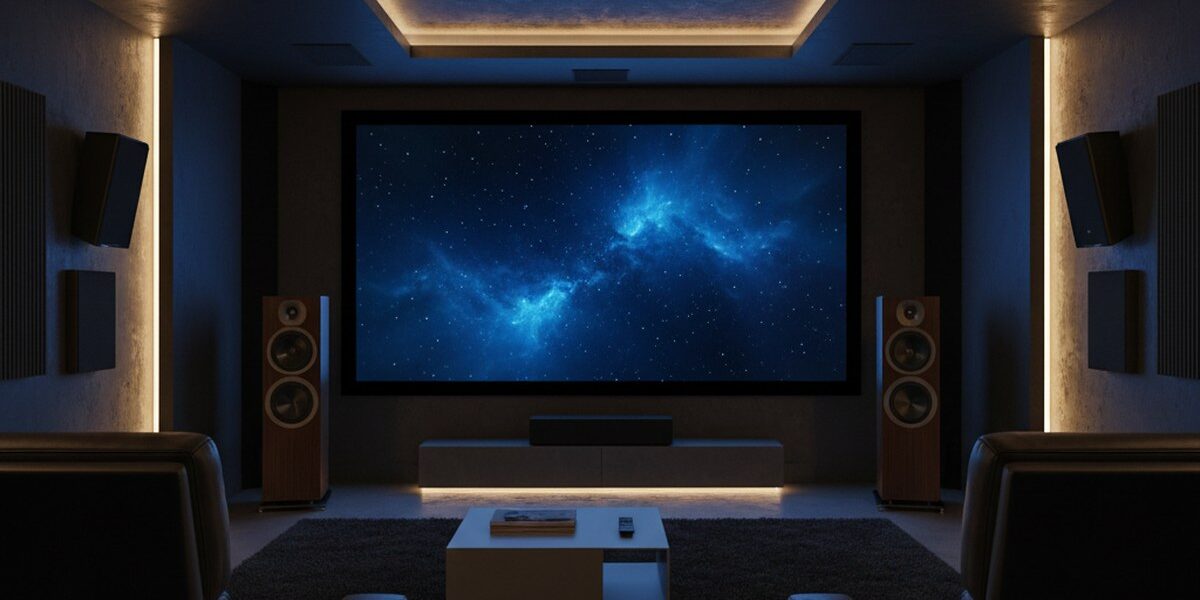
- Perforated screens: The main acoustic advantage of projectors is the ability to use acoustically transparent (perforated or woven) screens. This allows the center channel and front speakers to be placed directly behind the screen. Why is this important? Because the sound will come directly from the center of the action, from the characters' mouths, from the epicenter of explosions, and not from below or from the side. This significantly improves the localization of sound images and creates a more realistic soundstage. In a cinema project on Leninsky Prospekt, we used exactly such a screen, and the client was amazed at how accurately the sound matched the picture.
Disadvantages and features of acoustics:
- Projector noise: Even the quietest projectors emit some noise from the cooling system. This noise may be unnoticeable during loud scenes, but during quiet moments or dialogues, it can be distracting. This requires additional sound insulation for the projector niche or box, as well as careful selection of the projector itself.
- Placement: A projector requires a certain distance to the screen and precise positioning, which sometimes complicates room planning.
- Screen reflections: Even if the screen is perforated, its material can affect the high-frequency component of the sound. This requires careful calibration and, possibly, the use of an equalizer for compensation.
- More demanding for soundproofing: Because a home theater with a projector is usually perceived as a “real” cinema, higher demands are placed on its sound insulation from external noise so that nothing distracts from the immersion.
Home theater with TV
Advantages:
- Ease of installation: A TV is easier to install; it doesn't require room darkening or special projector mounting.
- No noise: Modern TVs are virtually silent.
- Flexibility of speaker placement: Since a TV is not acoustically transparent, the front and center channels are located on the sides and below the TV. This gives more freedom in room design but requires more careful adjustment of delays and sound levels to compensate for the sound source displacement.
Disadvantages and features of acoustics:
- Limited size: Even the largest TVs (98-100 inches) cannot compare to a 120-150-inch projection screen. A smaller screen size can reduce the immersion effect, and then the sound has to work even harder to compensate for it.
- Center channel placement: This is the main acoustic problem of TV installations. The center channel, which is responsible for dialogues, has to be placed under the TV. This leads to the characters' voices seemingly "detaching" from their image, dropping downwards. Although modern AV receivers and processors have functions that allow the soundstage to be raised slightly, it will never be as natural as placing the speaker behind a perforated screen. In one of our projects for a client from Yekaterinburg, we spent a long time explaining this feature, offering compromise solutions using built-in acoustic systems as close as possible to the bottom edge of the TV.
- Screen reflections: The smooth surface of a TV is an excellent sound reflector, especially for high frequencies. This can create unwanted reflections that degrade the clarity of the sound image. More active use of sound-absorbing materials on walls and ceilings is required to minimize these effects.
What to look for when planning
Regardless of the choice, 360° Space Acoustic recommends starting with an acoustic project. We always begin with a 3D scan of the room – this is the basis for accurate calculations. Based on this, we model the acoustic environment and offer solutions.
For projector:
- Screen selection: Don't skimp on an acoustically transparent screen. Different materials have varying degrees of transparency and can affect sound differently. We select the optimal option based on the characteristics of the acoustics and the projector.
- Projector soundproofing: If the projector will be in the room, provide a soundproof box or niche for it in advance. When measuring RT60, we found that even a quiet projector installed without isolation raises the background noise by 5-7 dB, which is critical for comfortable viewing.
- Subwoofer placement: A large screen often provides more space for multiple subwoofers, allowing for more even bass throughout the listening area.
For TV:
- Center channel: Try to choose the lowest-profile center channel possible or consider an in-wall speaker option that can be placed directly under the TV in a special niche.
- Acoustic treatment: Given the reflective properties of a TV, pay more attention to sound absorption on the walls, especially the side ones, and the ceiling. Decorative acoustic panels can be a stylish and functional solution.
- Calibration: With a TV, calibrating the acoustic system becomes even more important to compensate for the imperfect placement of the center channel and minimize the impact of reflections.
In both cases, whether it's a projector or a TV, proper planning and professional acoustic design from 360° Space Acoustic will allow you to get the most out of your system. We work throughout Russia, with offices in Moscow and St. Petersburg, and are ready to help you create the perfect home theater where sound and image will work in complete harmony.
Frequently asked questions
Q: Can I buy a projector/TV first, and then deal with acoustics?
A: Not recommended. The choice of display directly affects acoustic design. If you purchase the display first, it may turn out that its location or type is not suitable for optimal sound, and you will have to make compromises or even change equipment.
Q: How much does an acoustically transparent screen affect image quality?
A: Modern acoustically transparent screens minimally affect image quality. With proper selection and installation, the difference will be imperceptible to most viewers, especially considering the advantages in the soundstage. We carefully select such screens based on the projector's characteristics.
Q: Do I need soundproofing if I live in a private house?
A: Yes, sound insulation is important even in a private house. It not only prevents sound from spreading to other rooms of the house but also protects against external noises, such as passing cars or barking dogs, which can distract from viewing. In one of our projects in a cottage village, the client was sure that he did not need sound insulation, but after the very first test listening with an active subwoofer, he agreed to our recommendations for improvement.
Need acoustics advice?
Leave your contact — we'll respond within 30 minutes and calculate the cost