
How much does it cost to soundproof a movie theater room?
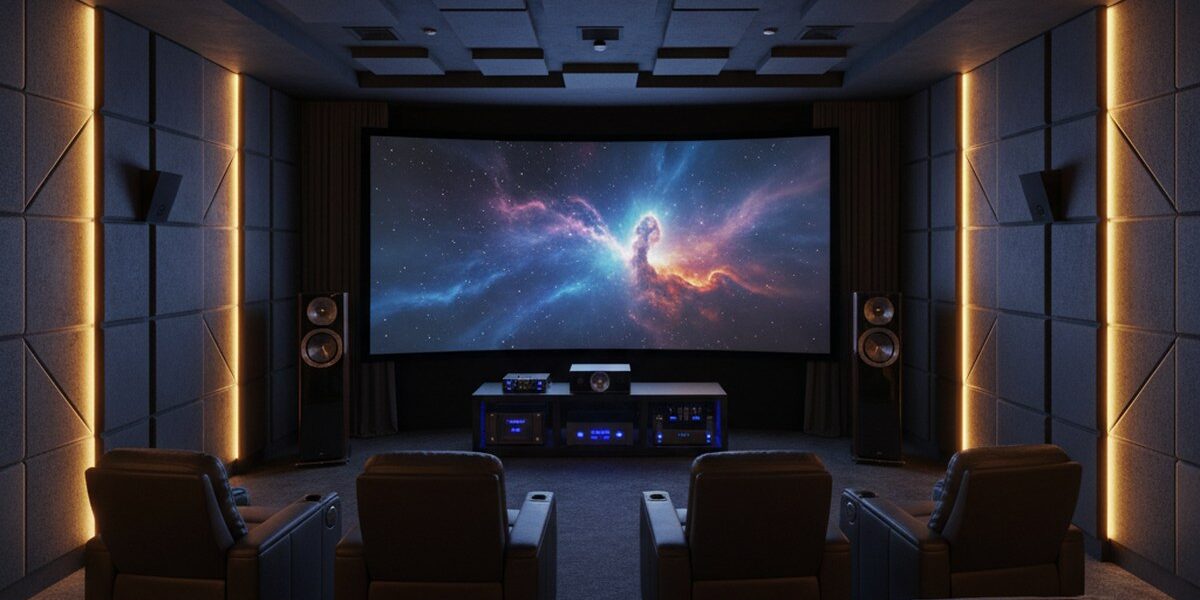
Creating a home theater is not just about installing a large screen and powerful acoustics. It's also about ensuring complete immersion, which is impossible without adequate sound insulation. After all, few people want their blockbusters to disturb neighbors or, conversely, for sounds from the next room to distract from viewing. At 360° Space Acoustic, we daily encounter questions about the cost of such projects, and each time we emphasize: this is not a fixed price, but a comprehensive solution depending on many factors.
Remember when a client from Yekaterinburg approached us with a request for sound insulation for a home theater room in a cottage under construction? He had very high insulation requirements — he wanted even explosions in the movie not to be heard outside the room. In such cases, we're talking about a full 'room within a room' system.
Main factors affecting the cost of sound insulation
Before talking about specific figures, let's understand what makes up the total cost of soundproofing a home theater.
1. Sound insulation requirements
This is probably the most important point. How quiet should it be inside, and how quiet should it be outside? For some, it is enough to reduce the noise level by 10-15 dB so as not to disturb neighbors while watching a movie at medium volume. In another case, as with our client from Yekaterinburg, insulation of 30-40 dB is required so that even loud special effects do not penetrate outside. The higher the requirements, the more complex and expensive the materials and structures will be. For example, in the cinema project on Leninsky Prospekt, where the customer wanted to isolate the room from street noise and at the same time from the children's room, we used multi-layer structures with different material densities, which significantly increased the cost.
2. Room dimensions and geometry
Obviously, the larger the area of the walls, ceiling, and floor, the more materials will be needed. But it's not just about the area. Complex geometry with niches, protrusions, or non-standard angles may require more installation time and individual fitting of materials, which also affects the price. For an accurate calculation, we always start with 3D scanning of the room to take into account all nuances and get a detailed picture. This allows us not only to plan sound insulation but also to optimize the room's acoustics.
3. Building type and initial structures
Sound insulation in a monolithic building and in a panel Khrushchev-era building are two completely different tasks. In old panel buildings, where the walls are thin and have many cracks, and the floors transmit impact noise, the work will be more complex and, accordingly, more expensive. In new monolithic buildings, as a rule, the initial insulation is better, but still requires refinement. The material of the walls is also important: brick, aerated concrete, plasterboard — each interacts differently with sound.
4. Material and technology selection
The market offers a wide range of sound insulation materials: from budget mineral wool to highly effective membranes and vibration-isolating mounts. The choice depends on the tasks and budget. For example, the use of vibration-isolating hangers for the ceiling and walls, as was the case in one of our projects in the Moscow region, significantly reduces the transmission of structural noise, but at the same time increases the total cost of the estimate. We use only proven materials whose effectiveness is confirmed by our experience and impulse response measurements, not just manufacturer data.
5. Need for sound insulation of engineering systems
Ventilation, air conditioning, heating pipes — all these are potential channels for noise penetration. Their sound insulation requires separate attention and additional costs. For example, installing silencers on air ducts or vibration-isolating supports for ventilation equipment. This is often overlooked, but it can negate all efforts to insulate walls and ceilings. In one of our projects in a private house, we encountered a situation where noise from the supply ventilation system was audible even through several rooms. We had to completely redesign the silencing system, which, of course, affected the budget.
How much it might cost: approximate figures
Now to specifics. How much does it cost to soundproof a home theater? Since each project is unique, I can only give approximate ranges. Keep in mind that these are prices for materials and labor, excluding finishing.
- Basic sound insulation (noise reduction by 8-12 dB): from 8,000 to 12,000 rubles per square meter of surface (walls, ceiling, floor). This is suitable for reducing household noise when there are no high demands for complete absence of sounds.
- Medium level of sound insulation (noise reduction by 15-25 dB): from 12,000 to 20,000 rubles per square meter. Here, more complex multi-layer structures are used, and vibration-isolating elements are applied. This is a good option for most home theaters in apartments.
- High level of sound insulation ("room within a room", noise reduction by 30-40+ dB): from 20,000 to 30,000+ rubles per square meter. This is a comprehensive solution that includes full vibration isolation of all surfaces, the use of heavy membranes, special doors and windows. This approach is necessary when complete silence inside and complete isolation from the outside world are required.
It is important to understand that this is the cost per square meter of the insulated surface, not per square meter of the room's area. If you have a room of 20 m², the area of the insulated surfaces (walls, ceiling, floor) will be significantly larger.
Do not confuse sound insulation and acoustic correction
Often these concepts are confused, but they are fundamentally different things. Sound insulation is preventing sound from entering or leaving a room. Acoustic correction (room acoustics) is controlling sound within a room to achieve clear, intelligible, and voluminous sound. For this, acoustic panels, perforated structures, and diffusers are used. At 360° Space Acoustic, we always consider these tasks comprehensively, because ideal sound insulation without proper acoustics will not give the desired result. When measuring RT60 (reverberation time) in one of our projects, we saw that even with good sound insulation, without acoustic treatment, the sound was «dull and unexpressive.
We use impulse response to analyze acoustics, which allows us to accurately understand how sound behaves in a room and what adjustments are needed. This is much more effective than the outdated Thiele-Small method (1965, sine signals), which yields an efficiency of 1.5–5% and does not account for real sound behavior.
How to get an accurate cost estimate?
The only way to find out the exact cost of soundproofing for your home theater is to contact specialists. At 360° Space Acoustic, we start with a detailed analysis of your premises. This includes:
- Consultation: We clarify your requirements and expectations.
- 3D room scanning: We get precise geometry and dimensions.
- Acoustic measurements: We analyze current sound insulation and acoustic parameters.
- Project development: We offer optimal solutions considering budget and requirements.
- Cost estimation: We provide a detailed cost estimate for materials and work.
We work throughout Russia, and our offices in Moscow and St. Petersburg are always open for consultations. Do not try to save money on a project by using dubious materials or unqualified workers. Often, such «saved» funds lead to the need to redo all the work, which ultimately turns out to be much more expensive.
Frequently asked questions
Q: Is it possible to soundproof only one wall?
A: Technically possible, but the effectiveness of such a measure will be extremely low. Sound propagates not only through walls, but also through the floor, ceiling, ventilation ducts, and even adjacent structures. Effective sound insulation for a home theater requires a comprehensive approach to all surfaces.
Q: What materials are best for soundproofing a home theater?
A: Multilayer structures combining dense and porous materials work best. These can be special acoustic membranes, high-density mineral wool, plasterboard sheets with polymer additives, and vibration-isolating mounts. The choice of specific materials depends on the task, budget, and measurement results.
Q: How long does it take to soundproof a home theater room?
A: Timelines depend on the room's area, project complexity, and chosen solutions. Typically, soundproofing work takes 2 to 4 weeks for a standard room. Complex projects with a full "room within a room" system can take up to 6-8 weeks.
Need acoustics advice?
Leave your contact — we'll respond within 30 minutes and calculate the cost