
Built-in or external speakers: what's better for home cinema
Question "home theater built-in or external speakers» comes to us at 360° Space Acoustic from about every second client who orders a home theater. The dispute doesn't boil down to «more expensive — cheaper»: each option has its own physics, its own room limitations, and its own usage scenario.
The interior designer will push the owner towards built-in. The audiophile — towards large floor-standing Focal or Wilson. But the truth, as usual, lies somewhere in the middle and largely depends on the room geometry, the finishing budget, and how many hours a week movies are actually watched.
Let's analyze both options with numbers, not marketing promises.
Built-in speakers: acoustics you can't see
Built-in (in-wall and in-ceiling) are speakers in a flat enclosure, mounted flush with the wall or ceiling. The drivers and crossover remain the same as a regular speaker, but the enclosure becomes part of the room's architecture.
The main advantage is that the room acts as an infinite baffle. With proper installation, the front panel of the speaker is flush with the wall, and there is no diffraction at the cabinet corners. In impulse response measurements in a country house project near Istra, we saw a noticeably cleaner front wave from the built-in L/R pair compared to the same model in a separate enclosure.
The downsides begin where the perfect catalog picture ends:
- Behind the wall, a cavity of 40–80 liters per channel is needed — otherwise, the bass is suppressed, and the speaker operates in acoustic short-circuit mode.
- Gypsum board resonances. If a 12.5 mm sheet is undamped, at frequencies of 80–160 Hz, the wall starts to “hum” itself — we caught this during scanning in three consecutive objects.
- Sound insulation to the next room drops by 2–3 times. A hole for a speaker is a hole for sound.
- Service and upgrade require dismantling of finishes.
For the center channel and surround effects, built-in works almost always well. For the front L/R pair — only if a proper box with mineral wool and decoupling from the load-bearing structure is pre-installed behind the wall.
External speakers: classic with full control
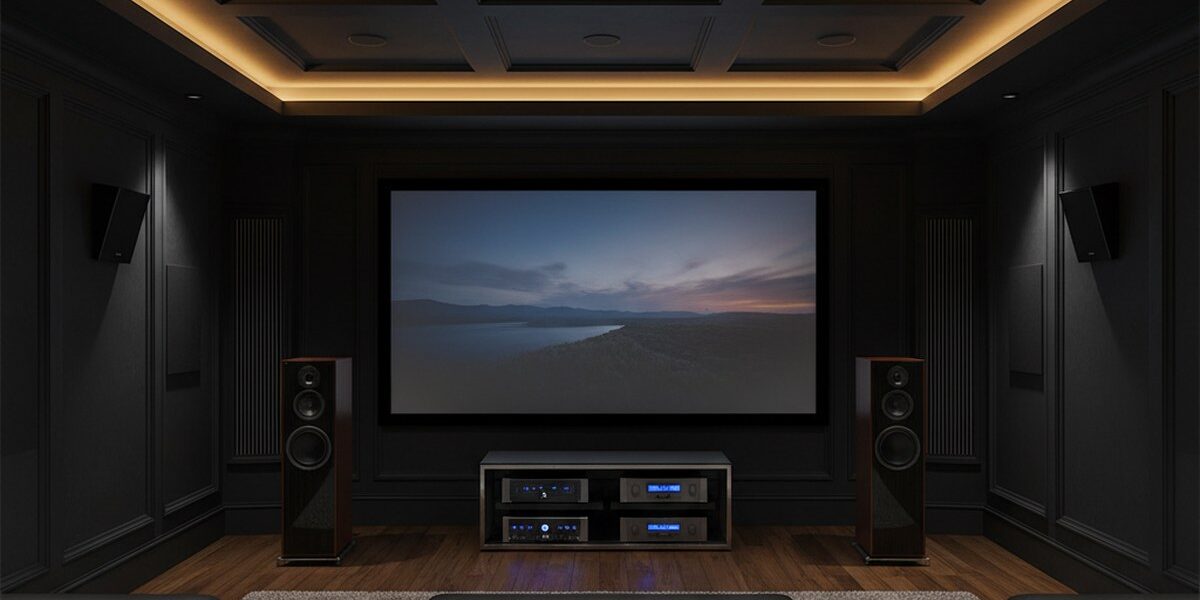
By "external" we usually mean floor-standing, bookshelf speakers on stands, or ON-WALL options in their own enclosure. The manufacturer designed the enclosure volume, bass reflex, damping — and vouched that the speaker plays exactly as intended.
This provides three practical advantages.
First — efficiency. The standard Thiele–Small method (1965, sine signals) gives high-quality floor-standing speakers an efficiency of 1.5–5%, which on scenes with dynamic content — explosion, gunshot, cinematic LFE roar — translates into an honest 105–110 dB peak without compression. Built-in often hits a ceiling of 100–103 dB.
Second — bass. A bass reflex enclosure at 30–35 Hz covers most of the cinema LFE band without a subwoofer. For a client from Ekaterinburg who had a hall installed in his cottage, we measured f-3 around 32 Hz from a pair of floor-standing speakers — you won't get that with built-in, even theoretically.
Third is the upgrade. A speaker can be replaced in a day, without destroying the wall.
All this comes at the cost of space and appearance. Good floor-standing speakers are two cabinets 1.1–1.3 meters high on either side of the screen, plus a center under the TV, plus four satellites around the perimeter. Not every wife will approve this — and in our practice, this is a more decisive argument than it seems.
Comparison by key criteria
| Criteria | Built-in | External |
|---|---|---|
| Maximum SPL without compression | 100–103 dB | 105–110 dB |
| Lower bound (f-3) | 50–60 Hz | 30–40 Hz |
| Wall sound insulation | Drops by 6–10 dB | Lossless |
| Visibility in the interior | Hidden flush | Visible cabinets |
| Installation cost | Requires carpentry and decoupling | Racks + cables |
The figures in the table are averaged across our projects over the past three years; the spread depends on the specific model and room.
What to choose in reality
When we receive a project at the construction or major renovation stage, and the client has a reserve of 15–20 cm wall depth — we confidently recommend built-in for the center and rear channels, and leave the front L/R pair as floor-standing or ON-WALL. This is a compromise that satisfies both the owner and their designer in 80% of cases.
If the renovation is already done and no one will allow drilling into load-bearing walls — definitely external speakers. No surface-mounted "built-ins" in a 7 cm thick drywall partition will play properly, proven by dozens of measurements.
And if the hall is built for reference cinema (Atmos 7.2.4, screen 3+ meters, dark room treatment) and the owner is ready to lay acoustic niches at the architecture stage — built-in will catch up and in some places surpass external solutions. But this is already a budget of 4–5 million for the acoustic part alone.
The main thing is not to choose the type of speakers by pictures. 3D scanning of the room and impulse response calculation provide a full correlation between objective measurements and subjective perception — after this, the decision becomes obvious after one conversation.
Frequently asked questions
Is it possible to install built-in speakers into an existing renovation without dismantling?
Technically yes — through mounting boxes in drywall. But the sound quality will be noticeably lower: there's not enough volume behind the speaker, and drywall resonates. Tolerable for rear channels, but not for front.
Does built-in acoustics significantly degrade sound insulation between rooms?
Yes. Each column is a hole in the wall measuring 0.05–0.1 m². Without a double layer of drywall with acoustic decoupling and a mineral wool-filled box, the neighboring room will clearly hear the movie.
What's more expensive in the end — built-in or external?
The speakers themselves are comparable in price. Built-in adds 30–50% for carpentry and acoustic boxes. External ones require stands and cable channels. For budgets starting from 800 thousand ₽, the difference is 10–15%, no more.
Need acoustics advice?
Leave your contact — we'll respond within 30 minutes and calculate the cost