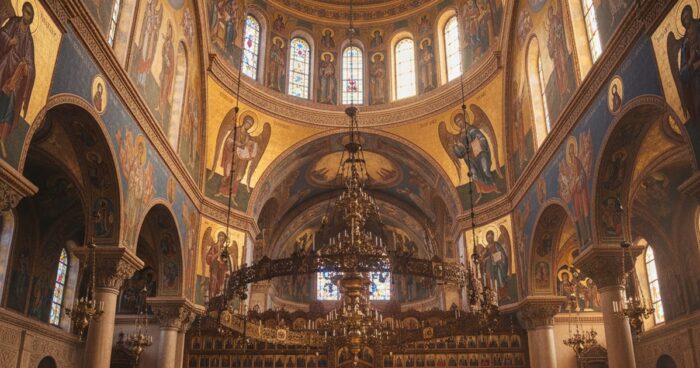
3D tour for churches and Orthodox temples: digital preservation of architecture In short: Creating a 3D tour for churches is not just a tribute to fashion, but an effective tool for preserving cultural heritage and expanding the audience. At 360° Space we digitize architectural masterpieces, making them available to millions, such as our project for the temple in Murom. Temples virtual tour is an opportunity not only to preserve the architectural and cultural heritage for future generations, but also to open it to a wide audience around the world. At 360° Space we see how such projects help churches and Orthodox temples become more accessible, attracting not only believers, but also everyone interested in history, architecture and art. This is an important step in the digitalization of cultural property. Our team regularly works with cultural heritage sites. We know how to delicately approach such filming, taking into account all the features and requirements. Why do you need a 3D tour for a church or museum? A 3D tour for a temple or museum is a powerful tool with many benefits that go beyond just “beautiful.” Here are a few key benefits that have been proven in our experience: Increased audience and accessibility. A virtual tour allows anyone to visit a temple or museum, regardless of their location and physical capabilities. For example, for temples located in hard-to-reach places, this is the only way to show them to the world. We were doing a project for a monastery in the mountains, where it is difficult for pilgrims to reach, and the 3D tour became a real salvation for them. Attracting donations and funding. The interactive tour may include buttons for donations or information about restoration work. This increases transparency and encourages assistance. We've found that properties with a quality 3D tour receive 15-20% more donations through online channels because people can see what they're investing in. Preservation and documentation. 3D scanning creates an exact digital copy of an object, recording its condition at a specific moment. This is invaluable for restoration, research and in case of unforeseen circumstances. Imagine how important this is for ancient frescoes or unique iconostases. Educational potential. The virtual tour can be supplemented with information points (Hotspots) with historical information, descriptions of icons, and architectural elements. This turns ordinary viewing into an exciting educational journey. Schoolchildren and students can study the history of the temple directly from lessons. Tourist attraction. For many regions, temples are key tourist attractions. A 3D tour on the website of a tourist office or city can significantly increase interest and attract real tourists. One of our clients from Kazan, the owner of a small museum, noted a 10% increase in traffic after publishing a 3D tour on a regional tourism portal. How it works: the shooting process, timing, result The process of creating a 3D tour for a temple or museum requires a special approach that takes into account the specifics of the object. We at 360° Space have developed a clear algorithm: Consultation and planning. First, we discuss your goals, features of the temple (size, lighting, presence of frescoes, icons), as well as the desired functionality of the tour (hot spots, audio guide, menu). It is important to understand what exactly you want to show and for whom. Visiting the site and filming. Our team arrives on site with professional equipment. Shooting 360° panoramas inside a temple is always a challenge. We use special cameras that allow us to obtain high-quality images even in difficult lighting conditions, which are typical for most temples. When photographing a temple with an area of about 300-500 m² with one nave, the scanning process itself takes 1-2 days. If it is a large cathedral with several chapels, it may take up to 5 days. Post-processing and assembly of the tour. After shooting, painstaking work begins on image processing, stitching panoramas, and creating navigation links between them. We add interactive elements: information windows, videos, photo galleries, audio guides. At this stage, we can also introduce 3D models of individual objects, such as antique utensils or icons, so that they can be viewed from all sides. Testing and delivery of the project. The finished tour undergoes thorough testing on various devices and browsers to make sure it works flawlessly. After your approval, we transfer all files to you or host the tour on our servers. The result is a fully interactive, high-quality 3D tour that can be embedded on your website, used on social media, or even shown at trade shows. We once did an offline version of a tour of the monastery for the exhibition “Orthodox Rus'”, so that visitors could “walk” around it without the Internet. See all projects → How much does a 3D tour for a temple or museum cost? The cost of a 3D tour for a temple or museum depends on several factors: the size of the object, the number of panoramic points, the complexity of the lighting, the need to add additional interactive elements (audio guide, pop-ups, 3D models), as well as the chosen method of placing the tour. For example, a basic 3D tour of a small temple (up to 100 m² and 10-15 points) can cost from 25,000 rubles. For large cathedrals, monastery complexes or multi-story museums, the cost will, of course, be higher. The price can reach 150,000 rubles or more if we are talking about several thousand square meters and hundreds of panoramic points with detailed elaboration and integration of complex functions. The price is also affected by the need to create 3D models of individual exhibits. We offer flexible options for storage and delivery of the tour: Cloud 360° Space: these are our high-speed servers with technical support, which ensures stable operation of the tour at any time. Customer server: if you have your own infrastructure, we can deploy the tour on your server. Offline version: offline build for PC or VR headset that works without the Internet. This is convenient for exhibitions or presentations. To get an accurate cost estimate, we recommend using our online calculator or contacting us directly. We are always ready to discuss your project and offer the optimal solution based on your goals and budget. Frequently asked questions Q: Can I add an audio guide to the 3D temple tour? A: Yes, of course! We can integrate an audio guide that will automatically play when you go to certain points or click on special icons. This greatly enriches the tour experience by providing visitors with historical and spiritual information. Q: How long does it take to create a 3D tour for an average-sized temple? A: For a medium-sized temple (for example, 200-300 m² with one or two naves), the filming process itself usually takes 1-2 days. Further post-processing and assembly of the tour takes from 1 to 3 weeks, depending on the complexity of the project and the number of interactive elements. We always try to work as quickly as possible, without sacrificing quality. Q: What should I do if there is poor lighting in the temple? A: Poor lighting is a common problem in ancient churches, but for us this is not a problem. We use specialized photography equipment and multiple exposure techniques to produce detailed, well-lit panoramas even in low light conditions. Our specialists are able to work with contrasting scenes, while maintaining the atmosphere and interior details. Calculate costProject catalogMatterport