

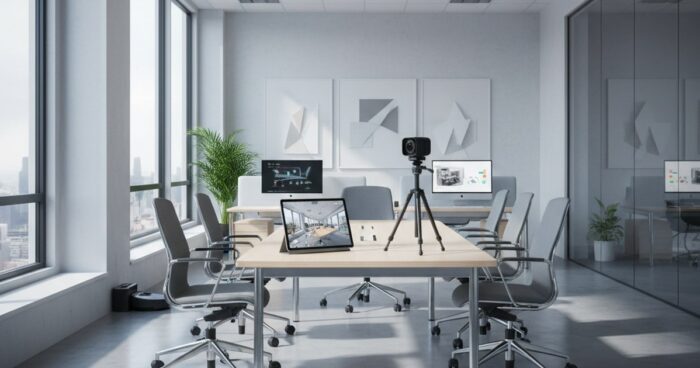
What is Matterport: a complete analysis of technology for business
What is Matterport: a complete analysis of technology for business In short: Matterport is the leading technology for creating detailed 3D tours of premises, which allows you to digitize space with high accuracy. It is widely used in real estate, hospitality, retail and many other commercial applications, offering an interactive and visual way to display properties. Curious about what Matterport is and how this technology can benefit your business? We, the 360° Space team, work with 3D tours every day and can tell you about Matterport from the inside, based on real project experience. It's not just a buzzword, but a powerful tool for visualizing spaces that has gained popularity due to its detail and convenience. Matterport is essentially a hardware and software package for creating immersive virtual tours. It captures real-life spaces and transforms them into interactive 3D models that users can freely navigate, examine details and gain information. Often clients come to us already knowing about Matterport because they have seen such tours from competitors or in the real estate industry. Why Businesses Need a Matterport 3D Tour Matterport-powered 3D tours offer businesses a range of tangible benefits that directly impact sales, marketing and operations. We see this in practice when our clients from different areas note specific changes after the introduction of tours. Increased potential customer engagement: Website visitors spend an average of 40% more time in 3D tours compared to viewing regular photos and videos. For example, for a hotel, this means that the guest “walks” longer through the rooms, restaurant and lobby, better imagining their future vacation. Reduce the number of empty showings or visits: In the real estate industry, 3D tours help weed out non-target clients. If a person has already “walked” around the apartment online, he will come to view only if the object is really interesting to him. This saves agents and owners time by reducing the number of ineffective showings by up to 30%. Expanding sales geography and audience coverage: For companies working with remote clients, a 3D tour is becoming an indispensable tool. A client from Vladivostok can examine the property in Kazan in detail without going to the site. This is especially true for purchasing real estate or choosing a venue for events. An effective tool for staff training and planning: Not just for clients! We have done tours for manufacturing plants where they were used to instruct new employees on safety or to plan equipment placement. The ability to “walk” through the workshop remotely greatly simplifies these processes. Increased trust and transparency: The openness and detail of the 3D tour creates a feeling of honesty and reliability for the client. You show everything as it is, without embellishment, which creates a positive brand image. How it works: the shooting process, timing, result The process of creating a Matterport 3D tour is quite streamlined and consists of several key stages. It all starts with preparing the object. Preparing the subject for shooting This is perhaps one of the most important stages, which is often forgotten. Before our team arrives, the facility must be prepared as much as possible: personal belongings have been removed, furniture has been arranged, televisions have been turned off, and doors between rooms have been opened. Imagine that you are preparing for a photo shoot for a glossy magazine - the same principles apply here. Any little thing caught in the frame will be visible in the 3D tour. For example, when renting a 600 m² restaurant, we always ask that all shopping carts and boxes be removed in advance. Filming process A specialized Matterport camera equipped with a lidar and several optical sensors is used for filming. The operator moves sequentially throughout the room, placing the camera at key points. The camera takes a full 360-degree photo and simultaneously scans the area, creating an accurate depth map. The distance between shooting points is usually 1.5–3 meters, but can vary depending on the characteristics of the room and the desired detail. This is painstaking work that requires care and experience. The average shooting speed is approximately 50–100 m² per hour, but much depends on the complexity of the room configuration, the number of doors, furniture and lighting. For example, a large warehouse with open space is rented faster than a multi-room apartment with narrow corridors. Processing and assembly of the tour After shooting, the data is uploaded to the Matterport cloud platform, where all scans are automatically stitched into a single 3D model. This process takes from several hours to days. Then our specialists get to work: adjust transition points, add information tags (Mattertags) with text, photos or videos, create a “Dollhouse View” and floor plans. We can also brand the tour by adding your company logo and customizing the color scheme. Result and placement formats As a result, you get an interactive 3D tour that can be embedded on your website, sent as a link in a messenger, or used for presentations. We offer flexible accommodation formats: Cloud 360° Space: Your tours will be hosted on our high-speed servers with 24-hour technical support. It is convenient, reliable and does not require any technical knowledge from you. Customer server: If you have your own IT infrastructure and strict data requirements, we can deploy the tour directly on your server. Offline version: Sometimes you need access to a tour without the Internet. We can prepare a standalone version for PC or a separate assembly for a VR headset. For example, we were asked to create an offline version for an exhibition to show real estate on a big screen without relying on Wi-Fi. See all projects → How much does a Matterport 3D tour cost? The price of a Matterport 3D tour consists of several factors, and it is always individual. There is no single tariff that would be suitable for all projects, be it a small cafe or a huge production complex. The main factors influencing the cost: Area of the object: The larger the area, the more shooting points are required, and the longer the operator’s work and subsequent processing takes. Configuration complexity: Multi-level objects, rooms with a large number of partitions or complex designs require more time and effort. Number of information tags (Mattertags): Each tag with additional information, photo or video is additional work to integrate the content. Need for additional services: Creation of floor plans, VR versions, or integration of specific elements. Travel costs: If the site is located outside the city where our team is based, travel costs will be added to the cost. On average, the cost of a Matterport 3D tour starts from RUB 15,000 for small objects. For larger or more complex projects the price will of course be higher. It is important to understand that this is an investment that pays off through increased marketing and sales efficiency. To get an accurate estimate, we recommend using our online calculator or contacting us directly. We are always ready to discuss the details of your project and offer the optimal solution, taking into account your budget and objectives. Frequently asked questions How is Matterport different from regular 360° panoramas? Matterport creates not just a set of panoramas, but a full-fledged 3D model of the space, through which you can move freely, see a “dollhouse” and floor plans. Conventional panoramas are static images connected by transitions, without true 3D dimension. What time...