

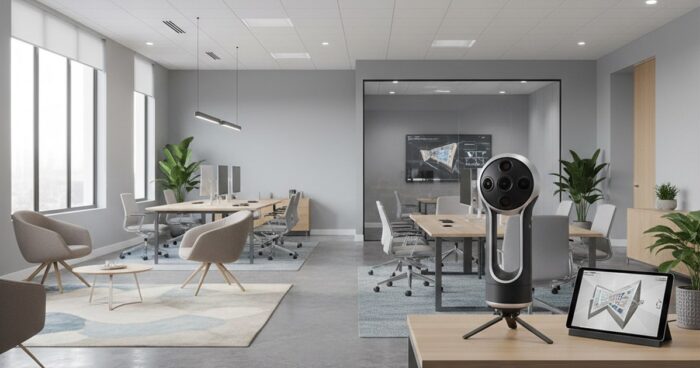
Matterport Pro 3: camera review, features and who it's suitable for
Matterport Pro 3: camera review, characteristics and who it’s suitable for Briefly: Matterport Pro 3 is a professional camera with a LiDAR scanner with a range of up to 100 meters, films both indoors and outdoors. During the shift, the 360° Space team scanned a shopping center with an area of 3200 m² in Nizhny Novgorod, the tour was assembled in three days. Matterport Pro 3 is the flagship camera of the American company Matterport, built around a LiDAR sensor and a 134 MP per frame matrix. Unlike the previous Pro 2, the third model works confidently outdoors: the sun no longer bothers it. We took it to the park first - we rented a loft with panoramic windows, where the Pro 2 had previously produced “holes” in the geometry. There were no holes here. The camera is designed for renters who sell tours as a product: premium real estate agencies, developers, museums, industrial facilities. For a home blog it is redundant, but for a hotel with 80 rooms or a production workshop it is definitely not. Why does a business need a 3D tour? We have been calculating the effect of client projects for six years and this is what we see in the numbers: Time on the site increases by 4–7 times. The average visitor spends 5-8 minutes on a tour page versus 40-70 seconds on a regular gallery page. For a developer client from Kazan, the conversion to an application increased from 1.2% to 3.8% after embedding the tour on the residential complex card. Minus 30–50% of “empty” views of the object. Realtors from St. Petersburg said: before the tour, 15 people came to the apartment in business class, bought 1. After that, 6 came, bought 2. People are eliminated at the online viewing stage. Acceleration of approvals by 40–60%. Architects and contractors see the object 1:1 without visiting. One customer, a chain of coffee shops, agreed on a new hall format for a tour with all regions in one Zoom. Increase in search traffic. Google and Yandex love pages with interactive content: viewing time is a signal of quality. At the museum in Yaroslavl, organic traffic increased by 34% in six months. Sales through VR display. A separate tour assembly for a Meta Quest or Pico headset closes deals at international exhibitions without the client physically traveling. How it works Shooting with Matterport Pro 3 takes place step by step: the operator places the camera on a tripod, starts scanning from the tablet, the camera rotates for 20–25 seconds, LiDAR reads the geometry, the lens takes a panorama. Next - move 2–2.5 meters, the next node. Speed in practice: an apartment of 80 m² - an hour and a half, a restaurant of 600 m² - half a working day, a warehouse of 5000 m² - two shifts with one operator and an assistant. On the street, the camera shoots best in diffused light - the direct sun at 12 o'clock gives overexposure, we plan to shoot in the morning or evening. After field work, the point cloud and panoramas are sent to Matterport servers, where they are merged into a single 3D model. Usually we give the finished tour to the client in 24–72 hours - it depends on the volume and branding changes (logo, tags, audio guide, integration with CRM). The tour can be arranged in three ways. The first is the 360° Space cloud: our high-speed servers with technical support, the link is given to the customer, and an iframe is embedded on the site. The second is the client’s server: we deploy the assembly on the customer’s infrastructure, relevant for banks and government agencies with security requirements. The third is an offline version: a standalone build for a PC or a separate build for a VR headset, works without the Internet (we were recently asked to make one for a stand at Innoprom). See all projects → How much does it cost? The price of a tour on Matterport Pro 3 consists of three components: travel and filming, processing and assembly, accommodation with support. We have starting projects (apartment, small office) - from 15,000 ₽. The average commercial tour for 300–800 m² is from 35,000 to 90,000 rubles. Large objects - production facilities, shopping centers, museums - are counted individually: components, additional processing, VR assembly and tags are counted there. Compared to cameras like Insta360 or Ricoh Theta, Matterport is more expensive on small projects, but on projects over 500 m², the advantage in geometry and dimensional accuracy makes up for the difference. LiDAR gives an error of about 1% versus 5–7% for photo stitching. It is more convenient to look at the exact figure for your object on a calculator - it takes into account the area, urgency, number of floors and placement format. Frequently asked questions: Does Matterport Pro 3 shoot outdoors? Yes, third-generation LiDAR works at distances of up to 100 meters and is not afraid of sunlight. We photographed courtyards, parks, and industrial sites. There is only one limitation - rain and snow: drops fall into the sensor and damage the points. How is Pro 3 better than Pro 2? The LiDAR range has increased from 4.5 to 100 meters, the scanning speed of one node has increased by 3–4 times, and street photography has appeared. The panorama resolution is 134 megapixels versus 134 megapixels for Pro 2, but the geometry accuracy and color rendition are noticeably higher. Can a tour be embedded on any website? Yes, we provide the iframe code - it works on Tilda, WordPress, Bitrix, and any custom engine. If you need an offline display at an exhibition or in a showroom without the Internet, we assemble an offline version for a PC or VR headset separately. Calculate costProject catalogMatterport